








Technophobia Logo

A motorhome booking plugin powering two real campervan sites in Cumbria

A case study of the Motorhome Booking plugin — built originally for Wicham Parish Council's motorhome aire, now also powering Estuary View Escapes at Millom Pier. Bay-level availability, DVLA reg lookup, season-based pricing, warden frontend, SMS notifications. 12,000+ lines of properly engineered PHP.
UK FLAG
UK Based
Support
12k+
Lines of PHP
DVLA
Reg Lookup
iCal
Sync Built In
Project · Motorhome Booking

What the plugin actually does

Built originally as a bespoke solution for Wicham Parish Council's motorhome aire — a parish-managed pitch for campervans and motorhomes — then extended for Estuary View Escapes' commercial campervan site at Millom Pier. Two very different operational contexts, same plugin.
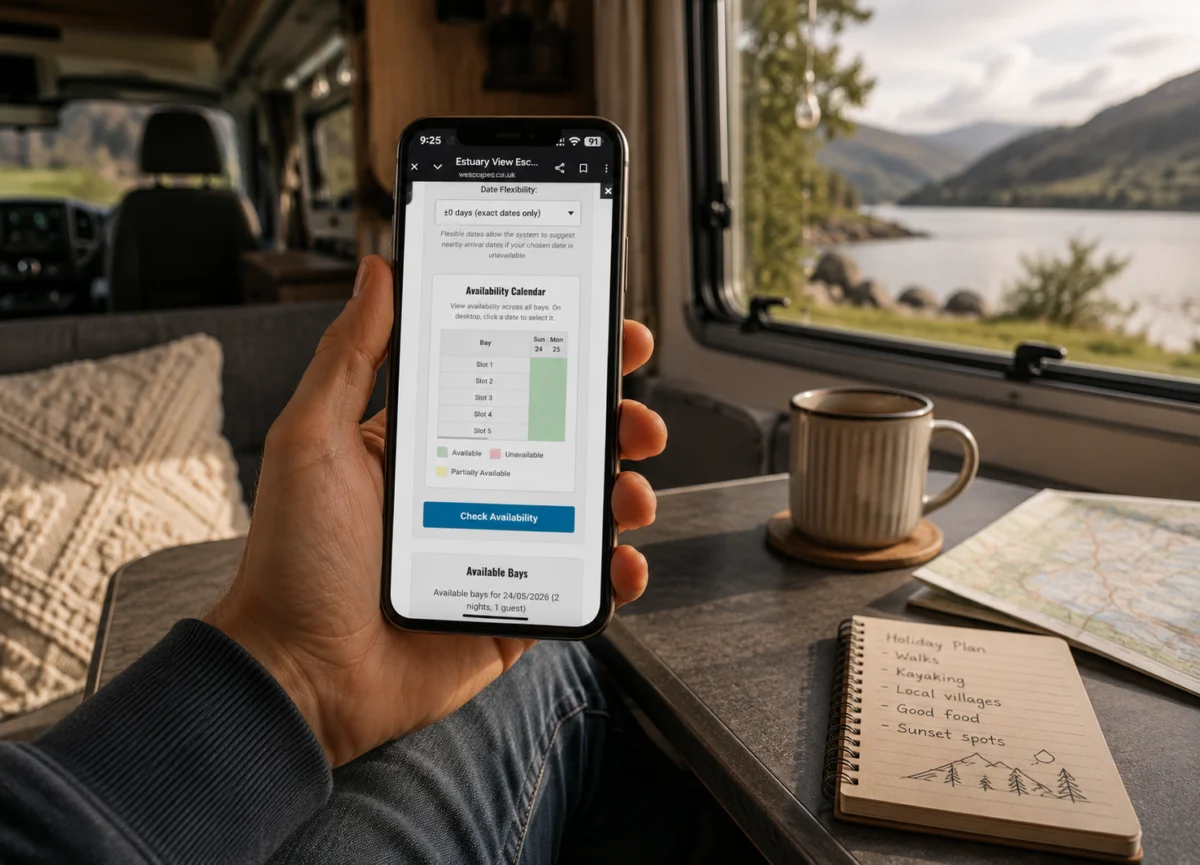
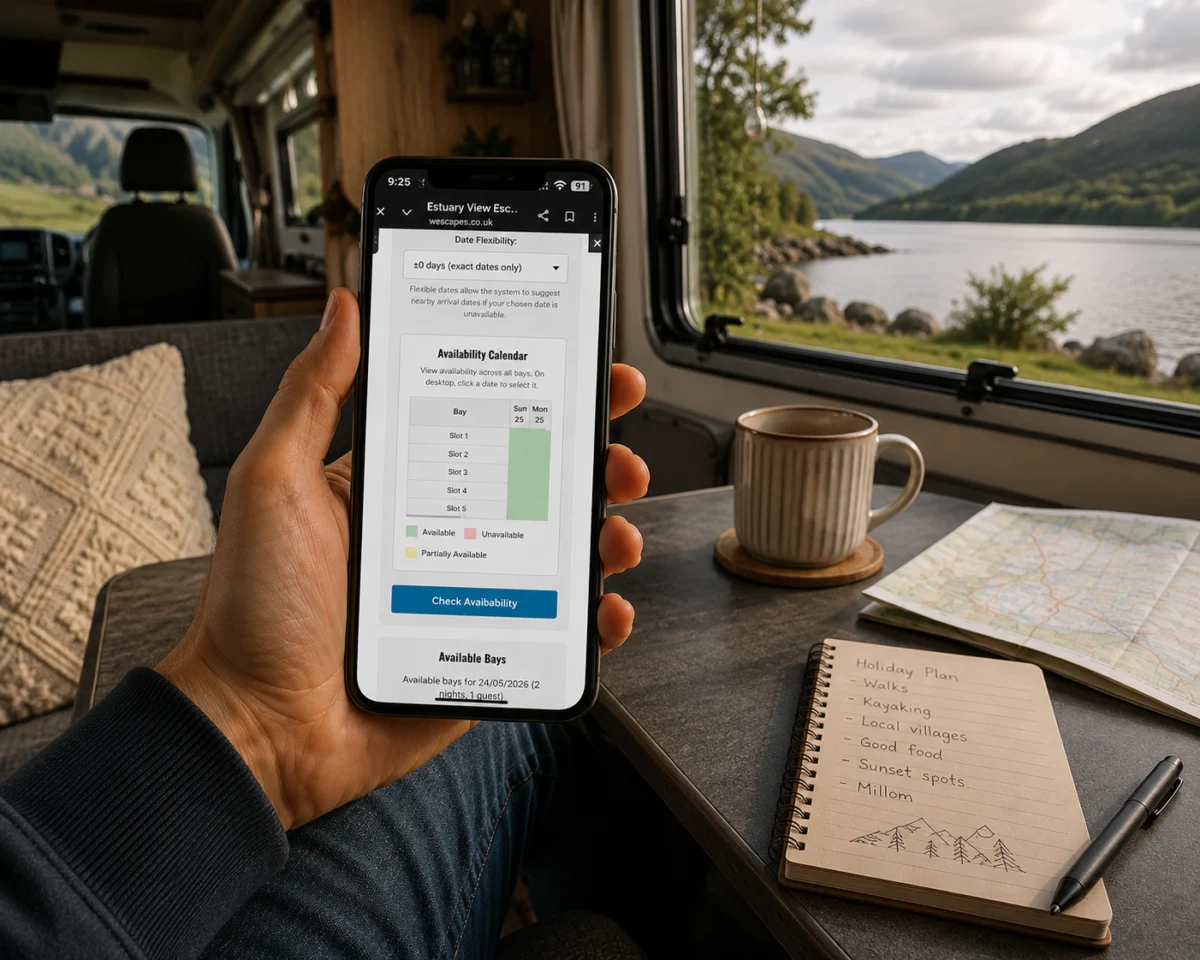
Bay-Level Availability
Each pitch (bay) is configurable individually. Some bays are EHU-equipped, some not. Some are dog-friendly, some not. Some have hardstanding, some grass. Customers book a specific bay, not just 'a pitch'.
DVLA Reg Lookup
Customers enter their vehicle reg at checkout. The plugin looks up the make, model and year via DVLA's API. The warden frontend shows the expected vehicle. Mis-typed regs caught at checkout, not at the gate.
Season Pricing
Different rates for peak, shoulder and off-season. Different rates per bay where applicable. Different rates for parish residents on the Wicham deployment. All configurable through the admin — no code changes needed for seasonal updates.
Warden Frontend
A separate tablet-optimised view for on-site staff. Today's arrivals, expected vehicles, payment status, customer notes, check-in actions. Designed for use on a phone or tablet at the gate, not at a desk.
SMS Notifications
Booking confirmations, arrival reminders, and exception notifications go out by SMS via Twilio. Useful for campervan customers who may be travelling and not checking email. Configurable per-deployment.
Audit Log Everything
Every booking, change, cancellation, refund and override logged with timestamp, user and reason. Parish councils in particular need auditable records — the plugin gives them a full trail by default.
Why custom instead of Pitchup or Booking.com

The maths of commission-based booking platforms

The Problem
Pitchup typically takes 5-7% of each booking. Booking.com 10-25%. On a typical £35 pitch night, that's £1.75-£8.75 going to the platform every time, every season, every year.
The Constraint
Off-the-shelf booking software designed for hotels doesn't model bay-level availability, warden frontends, or seasonal pricing the way campervan sites need. Workarounds are messy.
The Decision
Build properly. Plugin to existing WordPress sites. WooCommerce backing for payments. Real bay-level data model. Operational features the off-the-shelf platforms don't even attempt.
The Outcome
Two live deployments. Direct bookings flowing through without commission. Audit logs that satisfy parish council reporting. Warden workflow that makes check-ins faster than checking a clipboard.
The architecture

Pure PHP plugin. 12,000+ lines. 15 admin pages.

Motorhome Booking is built as a pure PHP WordPress plugin — no React frontend. The reasoning: bookings need to be SEO-indexable (so search engines can find specific pitches), and the warden frontend needs to work on the patchiest 3G signal at a campervan gate.

The plugin is 12,000+ lines of PHP across fifteen admin pages — bookings, calendar, bays, season pricing, blackout dates, bay maintenance, warden view, users, settings, instructions, audit log, export. Each admin page handles a specific operational concern. The data model uses custom database tables with versioned migrations and full referential integrity.

Behind the scenes: WooCommerce integration for payments and refunds, DVLA API for vehicle reg lookup, Twilio API for SMS notifications, iCal export for channel manager sync (so Pitchup or Airbnb can read the calendar even when bookings are taken direct).

It is one of our older plugins and a demonstration that pure-PHP plugins remain a viable architecture when SEO, signal reliability or admin-heavy workflows favour it over a SPA approach.
Two deployments, one codebase

Wicham Parish Council and Estuary View Escapes

The plugin runs on two production sites with quite different operational profiles.

Wicham Parish Council runs a council-managed motorhome aire — a small pitch facility funded and operated by the parish. The pricing reflects parish-resident discounts. Bookings need full audit trails for council financial reporting. The warden frontend is operated by volunteer staff on rota. Compliance with public-sector accessibility standards mattered from the start.

Estuary View Escapes runs a commercial campervan site at Millom Pier. Higher booking volume, more bays, commercial pricing tiers, full marketing integration. The warden frontend is operated by paid staff. Direct bookings replace what would otherwise flow through Pitchup at 5-7% commission.

Same plugin, same codebase. The differences are configuration, not custom code. New deployments don't require new development — they require configuration of bays, pricing, and operational rules.
iCal sync and channel management

Direct bookings synced to your existing platform calendars

Both Wicham and Estuary View Escapes still maintain listings on third-party platforms — Pitchup, Booking.com, Airbnb — because some customers will only book through those platforms. The Motorhome Booking plugin keeps those calendars in sync with direct bookings via iCal export.

A direct booking comes in through the plugin. The iCal export immediately reflects that bay as unavailable for the booking dates. When Pitchup or another platform reads the iCal, it sees the bay as already booked and prevents double-booking automatically.

Conversely, the plugin can read iCal feeds from external platforms — so a booking taken on Pitchup blocks the same bay in the direct booking system. Bidirectional iCal sync works with any platform that supports the iCal standard, which is most of them.

This means clients can run the plugin alongside their existing channel listings without changing how they market — and gradually shift volume toward direct bookings as those become a bigger proportion of revenue.
Warden frontend in practice

Designed for use at the gate on a phone or tablet

The warden frontend is the part of the plugin that wardens actually use day-to-day. It is deliberately not a desktop admin panel — it is a mobile-first interface designed for use on a phone or tablet, at the gate, in any weather and on any signal.

Today's arrivals are listed by expected arrival time with the customer name, vehicle registration, expected vehicle make and model (from DVLA lookup), bay assignment, payment status and any customer notes. Wardens can mark check-in with a single tap. Late arrivals are flagged automatically. Departures are similarly tracked.

Quick actions handle the common exceptions — extending a stay, moving a customer to a different bay, applying a discount, recording a maintenance issue with the bay. Each action creates an audit log entry automatically.

The warden frontend works offline if the connection drops mid-shift — changes are queued and synced when signal returns. Critical when sites are remote or rural, which most campervan sites are.
DVLA integration — the small detail that makes a big difference

Catching mis-typed registrations before they cause problems at the gate

DVLA vehicle registration lookup at checkout is one of those small features that punches above its weight.

When a customer enters their vehicle registration at checkout, the plugin looks it up via DVLA's API and confirms the make, model, year and fuel type. The customer sees a confirmation message — 'Found: 2019 Ford Transit Custom' — and can correct if they entered a typo.

At the warden frontend, the expected vehicle make and model appear alongside the booking. When a vehicle arrives at the gate, the warden can quickly verify against the system. Mis-typed regs that would previously have caused a discussion at the gate are caught at checkout, not on arrival.

It is also useful for audit and compliance — vehicle records held are accurate, can be exported for reporting, and integrate cleanly with public-sector accessibility requirements where bay-allocation justification needs to be auditable.
What this proves

Pure PHP plugins are still the right answer when context demands it

TP Food and the LMS use React-heavy architectures because their workflows are interactive and benefit from a SPA approach. Motorhome Booking uses pure PHP because its workflows are admin-heavy and its operational reality (poor signal at remote campervan sites, SEO matters, wardens need offline-capable interfaces) favours a server-rendered approach.

The point: we pick the right architecture for the project, not the flashiest one. Some clients want React because it sounds modern; sometimes that's the right call. Some clients are surprised when we recommend pure PHP for parts of their build; sometimes that is the right call too.

The Motorhome Booking plugin is a demonstration that traditional WordPress plugin architecture — done properly, with audit logs, security checks, versioned migrations, mobile-optimised admin frontends and external API integrations — is more than enough to deliver production-grade software for many real businesses.

The methodology behind it is the same as our React-heavy builds. The result looks different — but the discipline doesn't change.
12k+
Lines of production PHP
15
Admin pages built
2
Live production deployments
5-7%
Commission saved per direct booking
Who else this approach works for

Industries where bay-level or unit-level allocation matters

Campsites & Motorhome Aires

Direct bookings, bay allocation, warden frontends. Estuary View Escapes, Wicham Parish Council.

Caravan Parks

Pitch-level allocation, season pricing, hookup-aware availability. Same plugin, different configuration.

Holiday Lets

Multi-property availability, deposits, guest portal. Holiday Home Booking plugin.

Self-Storage Facilities

Unit-level allocation, varying unit sizes, contract management. Could be adapted from Motorhome Booking architecture.

Marinas

Berth-level allocation, vessel registration lookup, tide-aware availability. Could be adapted similarly.

Parish Council Facilities

Audit logs, resident discounts, accessibility-compliant. Wicham Parish Council deployment.
What our motorhome clients say

Real wardens using the system every day

How we'd build yours

The same three-step process used for both motorhome deployments

Discover
Discovery workshop covering bay configuration, pricing rules, warden workflow, third-party platform integration, and audit requirements. Written scope and fixed-price quote after.
Build
Most motorhome booking builds take 6-10 weeks from scope agreement to live system. Staging URL from week one. Weekly demos. Every milestone documented.
Launch & Support
Deploy to your hosting. Train wardens on the frontend. 30-day bug-fix window. Optional ongoing support thereafter.
Common questions about motorhome booking builds

Things prospects ask before signing a build agreement

Can the plugin handle multiple sites under one owner?

Yes — multi-site support is built in. A single owner can manage several locations with separate bay configurations, pricing rules and warden assignments, all from one admin. Common for caravan park groups.

Yes. iCal sync works bidirectionally — bookings made through Pitchup, Airbnb or Booking.com block the same bay in the direct booking system, and direct bookings block availability on the external platforms automatically.

Yes. Refunds and partial refunds are handled through WooCommerce. Cancellation rules can be configured per-deployment — full refund within 14 days, 50% within 7 days, no refund inside 48 hours, or whatever your business policy is.

Yes. Volunteer wardens, paid staff and parish councillors are all supported as different user roles with different permission levels. The system supports tracking of which staff member made which change for full accountability.

Yes. The plugin generates revenue reports, occupancy reports, peak/off-peak analysis and bay-level utilisation data. Useful for setting next season's pricing and identifying which bays underperform. Exportable to CSV or Excel.

Fixed price after a discovery call. A motorhome booking system build typically falls between £8,000 and £18,000 depending on bays, integrations and warden frontend requirements. We invoice in milestones.
Tired of paying Pitchup commission on every pitch night?
Let's talk about what a custom motorhome booking platform would look like for your site.

Technophobia

n8n automation for small teams. UK-based. Fast turnarounds. Clear handovers.

Address
South Cumbria Skills Exchange
Millom
LA18 4JS
United Kingdom

Phone +44 01229 774591
Email hello@technophobia.uk

VAT registered • GDPR-aligned • Typical lead time: 1–2 business days